HOOF-it Blog
Preparing for your Farriers
Winter Grooming
Almost all adverse winter equine skin conditions result from a dirty coat. A dirty hair coat gives bacteria and fungi a perfect environment to get a foothold during the winter months. When your pony is in his winter coat, problems such as weight loss, skin abrasions, and skin infections are much more difficult to spot than when he is all slicked out in the summer months.
Navicular Syndrome
Dealing with Hoof Thrush
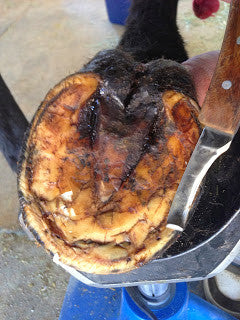
This spring as you go about your routine of picking out your horse’s hooves, you may discover an unusual thick black discharge and foul smell around the frog. These are the early signs of the hoof disease thrush. Thrush is an infection of the frog and of the surrounding tissue of the hoof. The bacteria associated with thrush infect the collateral and central sulci (creases) of the frog. The bacteria break down the tissue of the hoof, and this breakdown results in the foul odor and black discharge. If thrush is left untreated it can turn into a very painful problem in the heel area of your horse.
Thrush is likely to infect a horse which is living in unsanitary conditions. A wet environment that is made up of urine and acidity from manure is a breeding ground for the anaerobic bacterium that are attracted to any dead tissue that is on your horse’s frog. Also, people who have horses in a climate similar to the Pacific North West should keep a close lookout for this disease due to the constant dampness. The good news is that thrush is anaerobic, which means that this bacteria cannot live in the presence of air. The best way to avoid it in the first place is to keep your horse’s feet dry and clean so air can reach the tissue of the frog. A daily hoof picking does wonders. If not caught in the early stages the bacteria will form deep seated pockets and literally drill into the frog eating away the remaining healthy tissue.
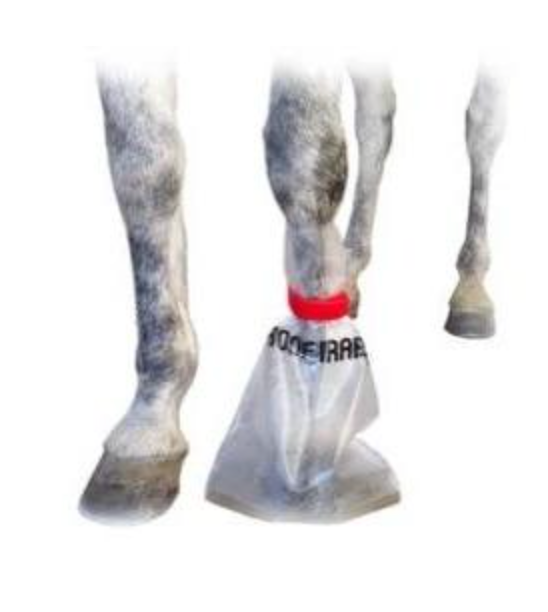
If you do happen to notice a pungent odor and a black discharge from your horse’s frog, some treatment will be necessary. Mild cases of thrush can be treated by removing dead tissue by trimming, scrapping, and vigorous scrubbing (debriding), of the frog and hoof wall. Moderate cases will need to be scrubbed with an antiseptic and treated daily with a topical spray after trimming and debridement. Severe cases of thrush will need repeated intense debridement followed by sterile bandaging and a quality topical thrush treatment. Your veterinarian may also recommend a tetanus shot.
With a careful eye, good hygiene, and quick treatment if needed, you will be able to prevent thrush from delaying you and your equine partner’s long past due spring ride.
If you have had any experience with thrush please post your comments here and share your knowledge with your fellow horse owners.
Performance Horse Shoeing Tips
No matter what kind of performance horse you might happen to have, cutting, reining, roping, or pleasure, one thing is a constant fact: your horse must be in balance with his body to perform at his optimal level. It is your farrier’s job to trim and shoe your horse to allow for optimal balance.
I have been lucky with my reining cow horse, Smoke ‘em. He has never needed any corrective shoeing. I simply have my farrier trim him flat and level based on the conformation of each of his legs. I have his feet trimmed short to ensure that he moves naturally. Horses with toes that are too long or heels that are too high do not stride naturally and do not look pretty to the judges. Eventually, excessively long feet cause problems that may require correction and even rehabilitation down the road. You can compare this problem to the human athlete. If a runner wore shoes one size too small, or too large, for even one training session he would feel a lot more stress and strain in the legs than with shoes which fit properly. The same is true for your horse. The most important factor in the shoeing of your performance horse is to have him land level on the ground, You can notice this by observing your horse move at a walk. View him from the front and from the side. Does the inside or the outside of the shoe hit the ground first? Or, does he put the entire hoof down level? If his walk is level, he will most likely lope and trot level also. And, most importantly for cow horses, he will stop level also. If he does not land perfectly level his timing (and yours) will be off. This problem will only get worse as you work him at a quicker pace. Remember, all foot and leg problems intensify as the horse moves faster. The best way to make decisions about your performance horse’s shoeing needs is to watch him move from the ground, and learn to listen to your seat. If you have any tips on shoeing the performance horse please post them here and share your experience.
Winter Horse Hoof Care
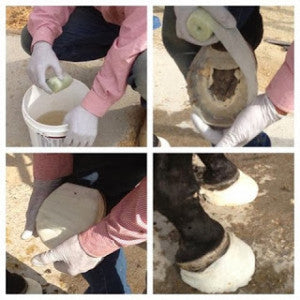
Winter is the time when a lot of horse owners choose to pull their horse’s shoes and let the hoof regenerate. Pulling the shoes and leaving your horse barefoot enhances the overall health of the feet. Hooves tend to grow more slowly in the winter months. However, the unshod feet should be trimmed regularly, 4 to 6 week intervals, with an emphasis on keeping the edge of the hoof sufficiently rounded. The hooves should also be painted twice a week with an appropriate hoof dressing. A little extra care and attention during the winter months when your horse is barefoot will result in a stronger healthier foot the rest of the year. However, there are more than a few of us who ride and compete in the winter months and pulling shoes is just not ever going to be an option. If you are like me and live in a snow filled winter environment you know that training outdoors, and trail riding, can cause problems for your horses feet. The main issue that I have to deal with when I am riding in the snow is “snow-balling”. This is when mixtures of snow, ice, mud, manure, grass, or bedding accumulate in the sole area. It can pack very densely into large rounded ice mounds that are almost impossible to chip out. When a horse is forced to stand or move on snowballs he has decreased stability in his fetlock joint. His weight is liable to roll medially, laterally, forward, or backward. It is extremely fatiguing for his muscles, tendons, and joint ligaments as he constantly tries to make adjustments to maintain balance. It is easy for a snowballed horse to lose his balance and wrench a fetlock. I have found a product that works perfectly for my horse, and is very easy for me to apply by myself. I use the HOOF-it Winter Snow Pad to keep my horse’s hooves clear of debris in the winter. With this pad in place I have full confidence in my horse’s footing while training outdoors in the snow, or trail riding. Let me know if you have tried HOOF-it Snow Pads and how they have worked for you.
Barefoot vs. Shoeing
Founder and Naviculer Help
Bryce Canyon Ride
What an experience! Greg and I arrived a day early to rest the horses after our long journey across two states from California to southwest Utah. Camp was nice with a few trees, sandy footing, showers, horse water, and outhouses. Anne and Dave Nicholson were courteous and welcoming. For the most part, about 75 to 80 riders started each day with a very high completion rate. The weather co-operated with us, but on day three in base camp we had a sudden hail storm which the riders missed out on the trail. We had applied Hoof-it before leaving home, and after a quick check to make sure all eight hooves of our two horses were covered, we started day one with much anticipation. Luckily for us, the ride started a little late as we forget to reset our clocks forward by one hour. The scenery was gorgeous with the Red Rocks providing a spectacular view. Besides the sandy soil and the Red Rocks, it felt like we were in the California Sierras most of the time. The footing was rather rocky and we re-applied Hoof-it to seven of the eight hooves after day one. Each day progressed into the next with the main difference being the accumulation of tiredness. Greg and I stayed in the back of the pack as Greg weighs in at 270 pounds with tack and I was on a fairly young horse who hadn’t even done two days in a row before. Greg did manage to finish all five days on the same horse and I finished day 1,2,4, and 5, giving my horse day three off. All the days were large loops with lunch being out of camp so we prepared crew bags which were taken out to lunch for us. Usually lunch was about 25 miles into the ride with great views, green grass for the horses to munch on, horse water, people lunch provided, and great vet checks. Most of the days were pretty technical and a seasoned horse sure helped. Some of the trail was following the side of a canyon, some of the trail took you right up to the edge of a mile long drop off with a birds eye view of the Red Rocks. There were places where the trail was on the side hill of a shale rockslide, but everything was passable with common sense and no sense of urgency - meaning slow down, dismount, walk your horse in hand, and pay attention. When it doubt, check it out! It wasn’t an easy ride on horse or rider. Some days we would climb up to 9500 feet, drop down to 6500 feet, climb again to 8000 feet, and repeat this process many, many times during the day. Other days we would follow the side of the mountains around one bend to the next, and after doing this about six or eight times, wonder if we would ever get to lunch. This is not a ride you would want to get hurt on. Many places it would have been tough to get you or your horse out. But the Duck was always aware of where his ducklings were, what they were up against, and remained a calm and commendable leader throughout the course of the week. There were quite a few rock sore horses by the end of the ride and some didn’t get to finish all five days. Ours looked great using Hoof-it for the duration of the ride. Some of the riders were using Easy Boots which worked ok, but some of the Easy Boots were pulled off in the bogs and muddy areas. We re-applied Hoof-it after some of the more rocky days, but after using it at home and on the single day rides, it was an easy job after we came in from the trail. Great ride, great trail, great company, and I’m glad I found Hoof-it.